SNAPCHAT UNDER HEAVY FIRE AFTER ADVERTISEMENT FAIL

Snapchat’s recent approval of an ad for a ‘Would You Rather’ game mocks victims of domestic violence and sparks public outrage.
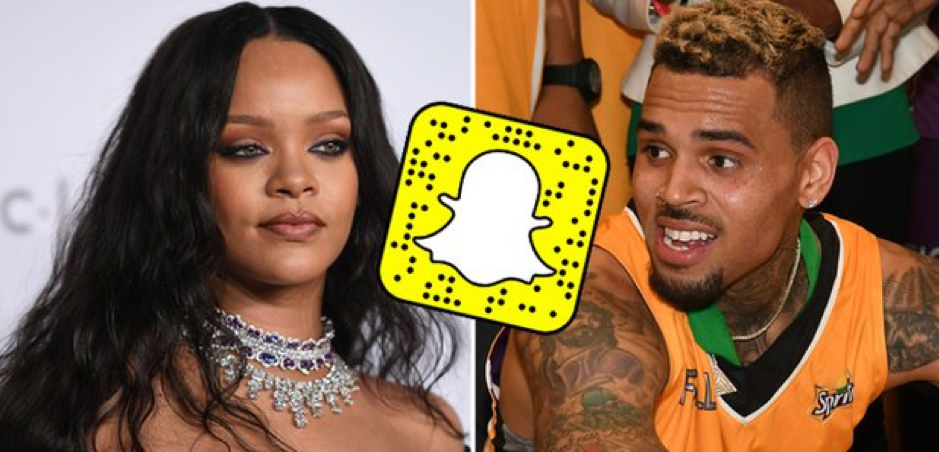
Multinational social networking site, Snapchat, upsets Rihanna

In March 2018, Snapchat featured a third party advertisement for a ‘Would You Rather’ game by the company, ‘Impossible Choices’ on their platform. The ad was accompanied with the caption, “Would you rather slap Rihanna or punch Chris Brown?” (Figure 1). The outrage that ensued was combined with Rihanna’s public criticism of Snapchat on her Instagram story for approving an insensitive ad which makes light of the serious contemporary issue of domestic violence (‘DV’). This cost Snapchat’s parent company ‘Snap Inc.’ approximately 4% in shares and $800 million overnight (Levin & Snapes, 2018).

Snapchat failed to implement their review process and let an insensitive and unethical ad slip through. The ad in question references a 2009 incident where Brown hit, choked, bit and tried to push Rihanna out of a moving vehicle. Brown pleaded guilty to felony assault and was sentenced to five years of probation (Serjeant, 2018).

KEY FACTORS CONTRIBUTING TO THE FAIL

The Double-Edged Sword of the ‘Glass Bedroom’ Phenomenon

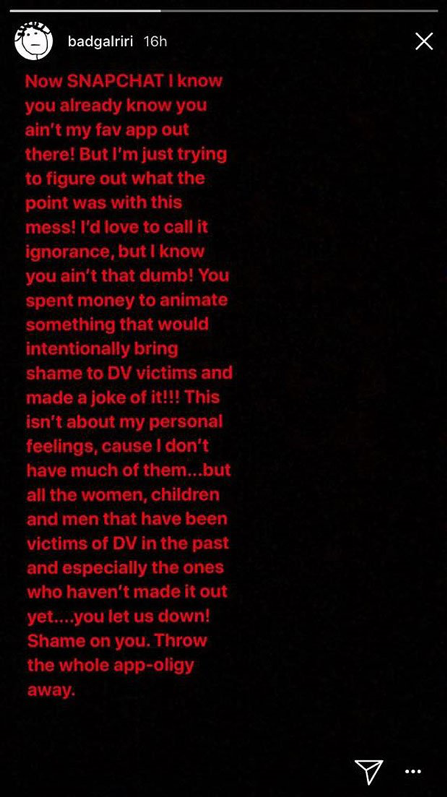
One of the main issues for Snapchat is that Rihanna is a public figure who is living in a ‘glass bedroom’. New media’s networked publics has blurred the public and private aspects of her life and transformed it into a subject of public discourse. Pearson has described the ‘glass bedroom’ metaphor as exchanges that are either “constructed with an awareness of the users beyond the glass walls [and] users outside the bedroom may engage or not” or exchanges that are “more closely guarded… and expecting those outsiders not to stand and watch” (Pearson, 2009). On one hand, Rihanna struggled to keep the DV incident from the public outside of the ‘glass walls’ due to the media and social networking sites. On the other hand, she possessed the power to call out Snapchat through Instagram with the goal of criticising them and holding them accountable (Figure 2).
Snapchat Failed to Recognise Its Invisible Audiences

In Rihanna’s Instagram story, she critiqued Snapchat’s lack of awareness of the invisible audiences the ad may have affected. The affordances of networked publics mean that invisible audiences such as lurkers that “share the same space but are not visible” exist on Snapchat (Boyd, 2010). Snapchat did not account for the fact that the invisible audience may have included past or current victims or other people that have been affected by DV. Historically, DV victims are afraid to speak up about abuse. The real world implication of this ad is that DV victims may feel like they are not being taken seriously if a platform as big as Snapchat endorses behaviour that turns their pain into a joke.

In a period of collapsed contexts, “it can be challenging to contend with groups of people reflect different social contexts and have different expectations as to what’s appropriate” (Boyd, 2010). As a multinational corporation who boasts over 300 million monthly active users around the globe, it becomes difficult for Snapchat to appeal to their users’ differing social expectations (Omnicore Agency, 2019). For instance, the Rihanna ad would have been more triggering to past or current DV victims whereas someone who hasn’t experienced it may see it merely as dark humour.

Failure in Content Regulation by Snapchat and the Implications

Traditional structures governing media have struggled to keep up with the rapid convergence of new and traditional media (Australian Government, 2012). In the US, safe harbour laws protect platforms such as Snapchat from being liable for the content of their users while simultaneously allowing platforms to include additional intervention measures (Gillespie, 2017). Snapchat provides such intervention measures in their Advertising Policies which state that all ads are subject to a review process and will be blocked if it falls under ‘prohibited content’ such as advertisements that encourage illegal activity or violence and content that “demeans, degrades, or shows hate toward a particular race, gender culture, country, belief, or toward any member of a protected class” (Snap Inc., 2018). So why was the Rihanna ad (seemingly ticking all those boxes) approved?

The affordances of Snapchat’s internal system allow users to flag inappropriate ads with a tap of their finger. These affordances illustrate Snapchat’s exploitation of the system of ‘participatory culture’ where there are increasingly “low barriers to… civic engagement” and the blurring of the distinction between producers and users (Jenkins, 2006). That is, the users (the public) have the ability to become the producers who curate and moderate content. This juxtaposes the traditional system where the media (e.g. news) provides content and the public merely consumes it. To a certain extent, this system saves human labour and costs. However, Snapchat has a mandate to govern the ads that appear on their platform through an internal review process. If they rely on a system of automation or users flagging ads, it creates opportunities for fails akin to the Rihanna ad to occur.

In fact, the combination of Snapchat’s reliance on participatory culture, automation and the technological affordances of social networking sites and networked publics fuelled the subsequent uproar of criticism. For example, Twitter’s ‘favourite’ and ‘retweet’ functions allowed millions of people to amplify Snapchat’s fail and share it to their followers.

AVOIDING THIS FAIL

Blend of Automation and Humans in the Review Process

To avoid similar fails, I would set up an automated system that flags certain keywords that are contained within a third party ad. A team of humans (from a diverse range of backgrounds and social contexts) should be employed to manually review and approve these ads to make sure that they account for any invisible audiences that may be affected. This team should be accompanied by a separate team who actively moderate content that has been automatically approved by the algorithm but hasn’t gone through humans. Whilst it is not realistic for every single ad to go through a human review process, humans must be a part of the review process in order to reduce the likelihood of similar situations arising in the future. This tightened review process keeps Snapchat’s brand consistent with the company’s ethos.

Improved Crisis Management and Response Framework

Snapchat’s response to the outrage acknowledged that they were wrong and apologised but did not address in detail how the fail occurred (which is crucial to a good crisis management response).

“The ad was reviewed and approved in error, as it violates our advertising guidelines. We immediately removed the ad last weekend, once we became aware. We are sorry that this happened. We are investigating how that happened so that we can make sure it never happens again.”

Snapchat Spokesperson

In fact, Snapchat has not updated the public on their findings or steps that they will take in the future since the making of this statement. From a crisis management perspective, I would have made a formal post addressing the fail and the steps that are being taken to investigate the cause of the issue. Upon the conclusion of investigations, I would have updated the public again on the findings and what frameworks are being put into place to prevent a similar fail from occurring.

Avoiding Sensitive Topics

Additionally, Snapchat should have avoided sensitive topics such as DV without a meaningful purpose (e.g. to raise awareness or support for DV victims). Future, if any, references to sensitive topics should also be accompanied with the relevant resources for help and helplines.

IN THE FUTURE
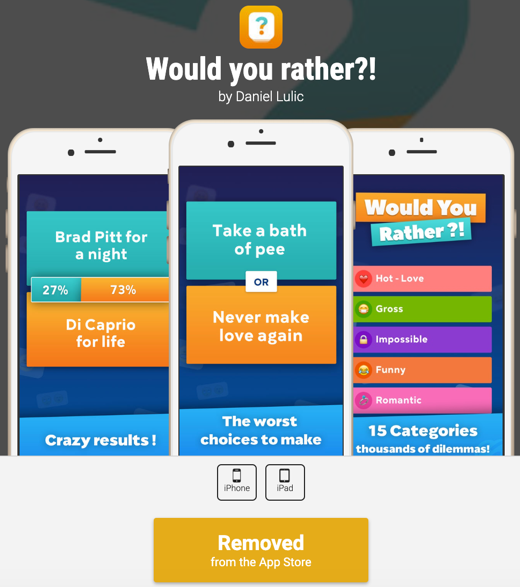
Moving forward, Snapchat should invest time into conducting at the minimum, basic research on third party advertisers. Upon some basic research on the developer of this game, Daniel Lulic, it was revealed that previous games made by him also sparked controversy (Safronova & Bowles, 2018). The app garnered waves of negative reviews on the Apple App Store. Unfortunately, images of these reviews cannot be shown as the game has been removed from the App Store (Figure 3).

However, the New York Times found a review from a user who said, “I am very disturbed with one of the would you rather questions. It’s under humour and it says Would you rather: Get raped by a llama or Rape a llama. No! Rape is NOT a joke!“ (Safronova & Bowles, 2018).

Ultimately, Snapchat did not effectively uphold their advertising policies which led to a disastrous social media fail with serious implications. If the recommendations above are implemented, it will significantly reduce Snapchat’s risks of making the same error again in the future.

BIBLIOGRAPHY

Australian Government. (2012). Convergence Review: Final Report. Canberra: Commonwealth of Australia.

Boyd, D. (2010). Social Network Sites as Networked Publics: Affordances, Dynamics, and Implications. Networked Self: Identity, Community, and Culture on Social Network Sites, 39-58.

Gillespie, T. (2017). Regulation of and by platforms. Thousand Oaks: SAGE Publications.

Jenkins, H. (2006, October 19). Confronting the Challenges of Participatory Culture: Media Education for the 21st Century (Part One). Retrieved from Confessions of an Aca-Fan: http://henryjenkins.org/blog/2006/10/confronting_the_challenges_of.html

Levin, S., & Snapes, L. (2018, March 16). Rihanna wipes $1bn off Snapchat after criticising app for making a ‘joke’ of domestic violence. Retrieved from The Guardian: https://www.theguardian.com/music/2018/mar/15/rihanna-snapchat-ad-domestic-violence-chris-brown

Omnicore Agency. (2019, April 27). Snapchat by the Numbers: Stats, Demographics & Fun Facts. Retrieved from Omnicore: https://www.omnicoreagency.com/snapchat-statistics/

Pearson, E. (2009, March 2). All the World Wide Web’s a Stage: The Performance of Identity in Online Social Networks. First Monday, 14(3). Retrieved from First Monday: https://firstmonday.org/article/view/2162/2127#p3

Safronova, V., & Bowles, N. (2018, March 15). Rihanna Protests Ad on Snapchat That Mocks Domestic Violence. Retrieved from The New York Times: https://www.nytimes.com/2018/03/15/style/rihanna-snapchat-stock.html

Serjeant, J. (2018, March 16). Rihanna urges fans to delete Snapchat after ad mocking assault by Chris Brown. Retrieved from The Sydney Morning Herald: https://www.smh.com.au/entertainment/music/rihanna-urges-fans-to-delete-snapchat-after-ad-mocking-assault-by-chris-brown-20180316-p4z4m7.html

Snap Inc. (2018, January 12). Snap Advertising Policies. Retrieved from Snap Inc.: https://www.snap.com/en-US/ad-policies/

IMAGE REFERENCES

Abad-Santos, A. (2018, March 15). Snapchat ran an ad asking users if they’d rather slap Rihanna or punch Chris Brown. Retrieved from Vox: https://www.vox.com/culture/2018/3/15/17124534/snapchat-rihanna-slap-ad

App Advice. (2018, August 24). Would You Rather?! by Daniel Lulic. Retrieved from AppAdvice: https://appadvice.com/app/would-you-rather/1149281412

Gonzales, E. (2018, March 15). Rihanna Savagely Responds to Snapchat’s Tone-Deaf Ad About Her and Chris Brown. Retrieved from Harpers Bazaar: https://www.harpersbazaar.com/celebrity/latest/a19445760/rihanna-response-snapchat-chris-brown-ad/
The Rise of Social Media and Its Ripple Effect on the Recording Music Industry

Image result for recording music

The rise of digital and social media in the past decade has caused major disruptions in the recording music industry and influenced changes in how an artist’s professional identity is shaped. The era of social media has facilitated shift from consumption of static information from producers to user generated content (Reinecke & Oliver, 2016). Traditional conventions and barriers of entry into the industry have been turned on their head albeit at the cost of increased competition. Particularly for independent artists, there has been pressure to reinvent to adapt to the rapidly changing industry ‘rules’ and stay ahead of competitors. This case study explores the convergence of social media platforms, participatory culture and its relationship with increased accountability of artists and how new media has upset the traditional conventions of the industry.


ENTRY INTO THE INDUSTRY (RISE OF SOCIAL MEDIA PLATFORMS)

Although the rise of social media has diminished the usefulness of record labels in an artist’s career, it would be ignorant to say that they aren’t important anymore; they are still a significant player in the industry. The overlap of social networking (SNS) and user-generated content sites (UGCs) such as YouTube and Soundcloud has birthed popular artists such as Justin Bieber, Alessia Cara, Halsey and Post Malone. This new model of convergence blurs the distinction between producers and consumers (Flew, 2014). For example, YouTube provides a comments section where consumers voice their opinions and essentially act as the ‘producers’ of the content.

Against the backdrop of new media, there have been “low barriers to public artistic express and civic engagement” (Morgan, 2016). As a result, it is becoming increasingly common for artists to take on producing, marketing and managing roles. This is an example of how social media has “democratised the means of promotion and the means of distribution; two capital-intensive areas in which the major labels had previously held an unassailable advantage” (Haynes & Marshall, 2017). However, the destruction of these barriers come at the cost of increased competition when anyone with a laptop and digital audio workstation (DAW) can make high quality records in their bedrooms.

Halsey’s Debut Concept Album ‘Badlands’

An example of this is Halsey’s bedroom produced album ‘Badlands’ which debuted at number two on the Billboard 200 chart and garnered 97,000 sales in the first week of its release (Hernandez, 2018). Ultimately, it has become easier for artists to network and find collaborators, translating into the promotion of positive brand equity where artists can offer an exchange of services to each other (Modicum, 2017).

How has the music industry adapted to these changes? Artists have utilised media platforms to reach new fans globally. Through features such as direct messaging on sites such as Twitter and Instagram, artists can also reach out to international artists for collaboration opportunities. For example, Dua Lipa (UK) and BLACKPINK’s (Korea) collaboration in 2017 (‘Kiss and Make Up’) was a result of Twitter fandom requests. The music video has accumulated over 100 million views by appealing to both English and Korean speaking fans.

PROFESSIONAL IDENTITY ON SOCIAL MEDIA PLATFORMS

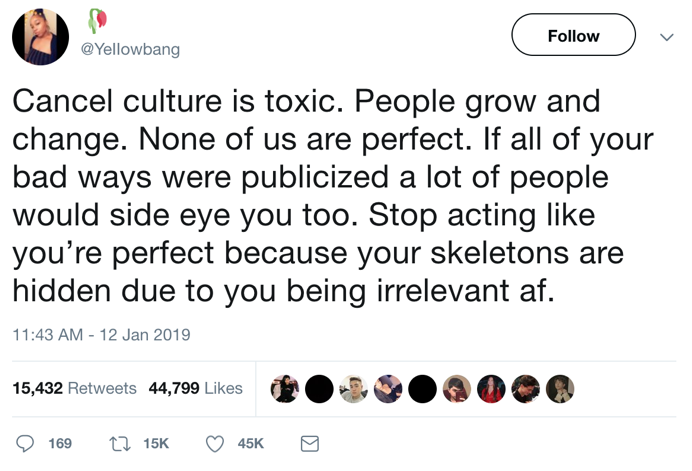
The way in which professional identity is shaped in the music industry has experienced drastic transformations. However, it hasn’t necessarily facilitated change in the nature of the job. Rather, it has changed how artists and fans interact and increased the likelihood of artists being held accountable for their words and actions. More and more, artists are defined by their online presence and ‘digital footprint’ with the growth of ‘crowd-criticism’ (Fengler, 2012). As the Huffington Post aptly put it, “you’re only as good as your last tweet” (Lauren, 2013). Consequently, ‘cancel culture’ has become a trend (especially on Twitter). ‘Cancelling’ occurs when the public “marks someone as problematic and withdraw[s] any and all prior support to ignore and exclude [them]” (Thomas, 2018).

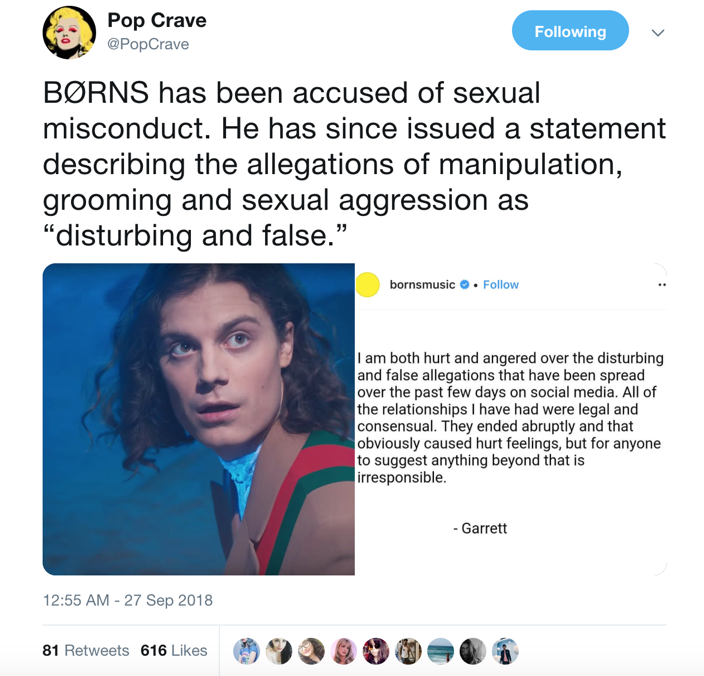
For instance, BØRNS is an indie-rock artist who was immediately removed as the headlining artist of ‘All Things Go Fall Classic’ music festival after sexual misconduct allegations despite his public response on Twitter (NBC Washington, 2018).

In response to this trend, some artists have begun employing people to sweep their social media accounts for controversial or problematic opinions.

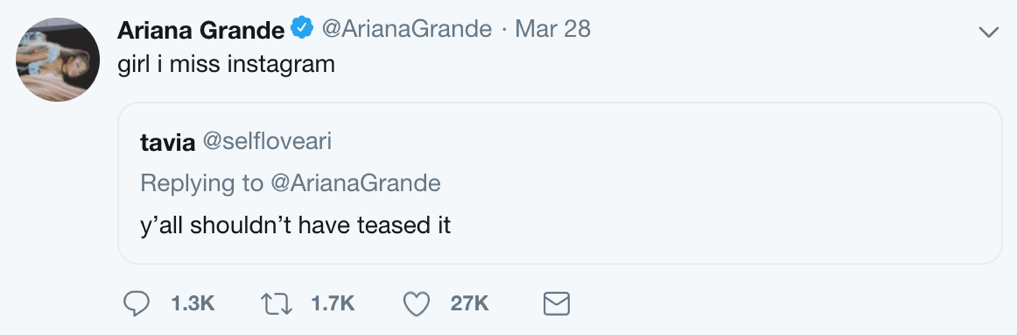
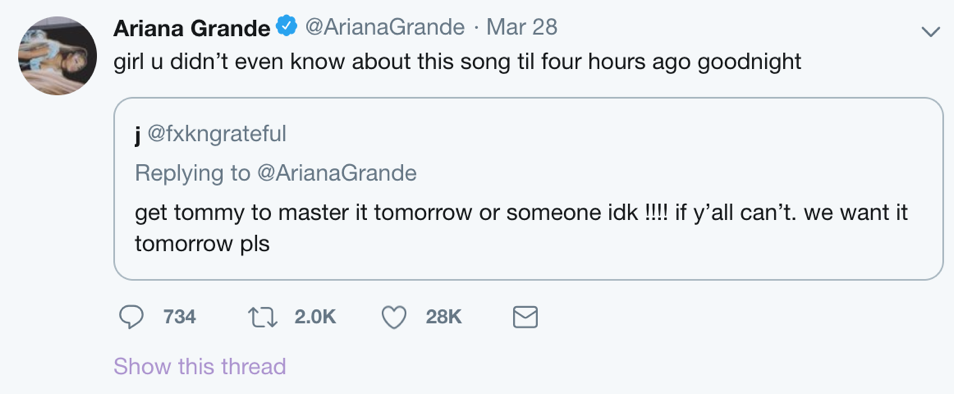
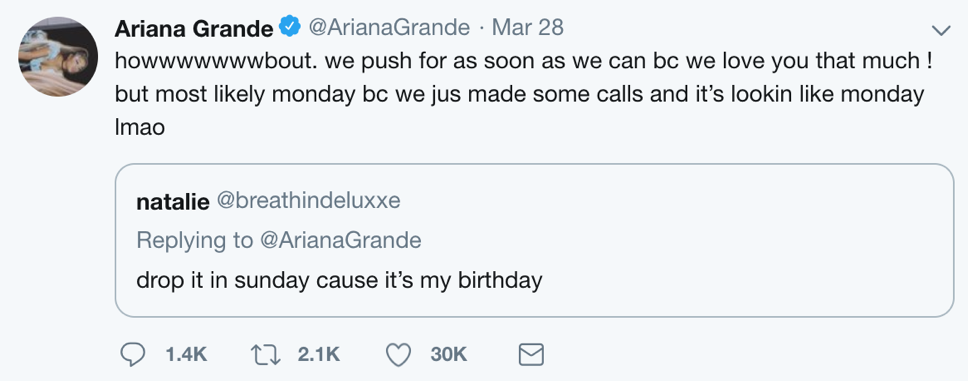
Sites such as Twitter have changed the way that artists approach fan interactions. They are now centred around building relationships with fans rather than marketing an artist as a product. Consequently, authenticity and genuineness have become increasingly valued by fans and consumers. These fan relationships have promoted the idea of participatory culture (Hutchins & Tindall, 2016). As mentioned previously, this increase in fan influence on production has blurred the lines between producers and consumers. A great example of this is Ariana Grande who is known for frequent interactions with her fans via Twitter.

Before and during her tours, she asks fans to comment songs they want to hear her perform and generally accommodates their preferences into the live show. It has become widely accepted within the industry that networking with fans are now a mandatory and necessary practice (Duffy & Pooley, 2017).


DIGITAL MUSIC STREAMING AND DISTRIBUTION

The revolutionary concept of music streaming via the convergent of social networking and user generated platforms such as Spotify and Apple Music set off the shift from physical CDs and radio to online platforms. Even though artists can now bypass the traditional conventions of relying on record labels to distribute their music to streaming platforms and radio, their physical sales have been compromised. As a result, artists have turned to touring as their main source of revenue. According to Nielsen Music’s ‘2018 Music 360 Report’, 53% of live music attendees listed “social media as [their] top source of discovery of new music” (Rys, 2018). It has been reported that from 2016-2017, the live concert sector has amassed 5.7 billion USD (16% increase) (Sanchez, 2018). As well as reducing costs in distribution, streaming platforms have made the consumption of music more affordable. For example, consumers can now pay a monthly Spotify subscription and have access to over 35 million songs (for the price of one album!) (Wolfe, 2018).

Image result for spotify friend feature
Friend Activity Feature in Spotify

The convergence of different types of social media have been beneficial to independent artists. For example, Spotify’s integration with Facebook allows consumers to follow their friends’ activity inside the app, create playlists (with a web link) and embed them on social networking sites (Collins, 2013). Post online streaming platforms, independent digital music distribution companies such as Bandcamp, CD Baby and Tunecore have emerged as new key players and distribution channels in the industry. These companies distribute your music to all major streaming platforms for a cost (either an annual subscription or a song-by-song fee). Most recently, Amuse was founded in 2015 and distributes all music for free and lets artists keep 100% of their rights and royalties (Amuse, 2019). In a move to adapt these changes, A&R (artist and repertoire) departments in record labels now have dedicated analytics experts who examine current trends and unsigned artists who are performing exceptionally well (Wolfson, 2018).

Ultimately, the introduction of digital and social media have played a significant role in lowering barriers of entry into the recording music industry. Through the convergence of social media sites, it has become easier for independent artists to market themselves, distribute their music and find success without the backing of a record label. Furthermore, the popularisation of participatory culture and new models which blur the distinction between producers and consumers have been a key factor in increasing artist accountability and transforming how artists interact with their fans. The shift towards new media has opened up a plethora of new opportunities within the music industry, particularly for independent popular music artists.


BIBLIOGRAPHY/REFERENCES

Amuse. (2019). About Amuse. Retrieved from Amuse: https://amuse.io/about

Collins, S. (2013, October 10). Spotify: merging music with social media. Retrieved from The Conversation: https://theconversation.com/spotify-merging-music-with-social-media-18401

Duffy, B. E., & Pooley, J. D. (2017, March 17). “Facebook for Academics”: The Convergence of Self-Branding and Social Media Logic on Academia.edu. Social Media + Society, 3(1).

Fengler, S. (2012). From media self-regulation to ‘crowd-criticism’: Media accountability in the digital age. Central European Journal of Communication, 1(9), 175-189.

Flew, T. (2014). New Media. Melbourne: Oxford University Press.

Grande, A. (2019, March). Ariana Grande. Retrieved from Twitter: https://twitter.com/ArianaGrande?ref_src=twsrc%5Egoogle%7Ctwcamp%5Eserp%7Ctwgr%5Eauthor

Haynes, J., & Marshall, L. (2017, June 4). Beats and tweets: Social media in the careers of independent musicians. New Media & Society, 20(5), 1973-1993.

Hernandez, L. (2018, September 3). Welcome To 3 Years Of Halsey’s ‘Badlands’: The record that shaped Halsey into the pop phenomenon she is. Retrieved from Odyssey: https://www.theodysseyonline.com/badlands-halsey-anniversary

Hutchins, A., & Tindall, N. T. (2016). Public Relations and Participatory Culture: Fandom, Social Media and Community Engagement. New York City: Routledge.

Lauren, L. (2013, September 26). You’re Only as Good as Your Last Tweet. Retrieved from The Huffington Post: https://www.huffpost.com/entry/youre-only-as-good-as-you_b_3983900

Modicum. (2017, July 8). Building Brand Equity. Retrieved from Forbes: https://www.forbes.com/sites/propointgraphics/2017/07/08/building-brand-equity/#4d214ac66e8f

Morgan, C. (2016, April 6). Digital Media, Participatory Culture and Difficult Heritage. Journal of African Diaspora Archaeology and Heritage, 4(3), 260-278.

NBC Washington. (2018, September 29). Børns was dropped from his headliner spot on the All Things Go Fall Classic lineup after two women accused him of sexual misconduct on their Twitter pages. Carly Rae Jepsen is now scheduled to headline Sunday. Retrieved from Twitter: https://twitter.com/nbcwashington/status/1046001944450535424?s=21

PopCrave. (2018, September 27). BØRNS has been accused of sexual misconduct. He has since issued a statement describing the allegations of manipulation, grooming and sexual aggression as “disturbing and false.”. Retrieved from Twitter: https://twitter.com/PopCrave/status/1044963723969003521

Reinecke, L., & Oliver, M. B. (2016). The Routledge Handbook of Media Use and Well-Being: International Perspectives on Theory and Research on Positive Media Effects. Abingdon: Routledge.

Rys, D. (2018, November 15). Nielsen Releases In-Depth Statistics on Live Music Behavior: 52 Percent of Americans Attend Shows. Retrieved from Billboard: https://www.billboard.com/articles/business/8485063/nielsen-releases-in-depth-statistics-live-music-behavior-360-report

Sanchez, D. (2018, October 26). The Live Music Industry Will Be Worth $31 Billion Worldwide by 2022. Retrieved from Digital Music News: https://www.digitalmusicnews.com/2018/10/26/latest-live-music-revenue-31-billion-2022/

Thomas, Q. (2018, November 6). Thomas ’21: Cancelling cancel culture. Retrieved from The Brown Daily Herald: http://www.browndailyherald.com/2018/11/06/thomas-21-cancelling-cancel-culture/

Wolfe, S. (2018, July 22). We compared Spotify and Apple Music subscriptions — and the winner is clear. Retrieved from Business Insider Australia: https://www.businessinsider.com.au/spotify-vs-apple-music-comparison-2018-7?r=US&IR=T

Wolfson, S. (2018, April 24). ‘We’ve got more money swirling around’: how streaming saved the music industry. Retrieved from The Guardian: https://www.theguardian.com/music/2018/apr/24/weve-got-more-money-swirling-around-how-streaming-saved-the-music-industry

Yellowbang. (2019, January 12). Cancel culture is toxic. People grow and change. None of us are perfect. If all of your bad ways were publicized a lot of people would side eye you too. Stop acting like you’re perfect because your skeletons are hidden due to you being irrelevant af. Retrieved from Twitter: https://twitter.com/YeIIowbang/status/1083902195865509889