
Snapchat’s recent approval of an ad for a ‘Would You Rather’ game mocks victims of domestic violence and sparks public outrage.

In March 2018, Snapchat featured a third party advertisement for a ‘Would You Rather’ game by the company, ‘Impossible Choices’ on their platform. The ad was accompanied with the caption, “Would you rather slap Rihanna or punch Chris Brown?” (Figure 1). The outrage that ensued was combined with Rihanna’s public criticism of Snapchat on her Instagram story for approving an insensitive ad which makes light of the serious contemporary issue of domestic violence (‘DV’). This cost Snapchat’s parent company ‘Snap Inc.’ approximately 4% in shares and $800 million overnight (Levin & Snapes, 2018).

Snapchat failed to implement their review process and let an insensitive and unethical ad slip through. The ad in question references a 2009 incident where Brown hit, choked, bit and tried to push Rihanna out of a moving vehicle. Brown pleaded guilty to felony assault and was sentenced to five years of probation (Serjeant, 2018).
KEY FACTORS CONTRIBUTING TO THE FAIL
The Double-Edged Sword of the ‘Glass Bedroom’ Phenomenon
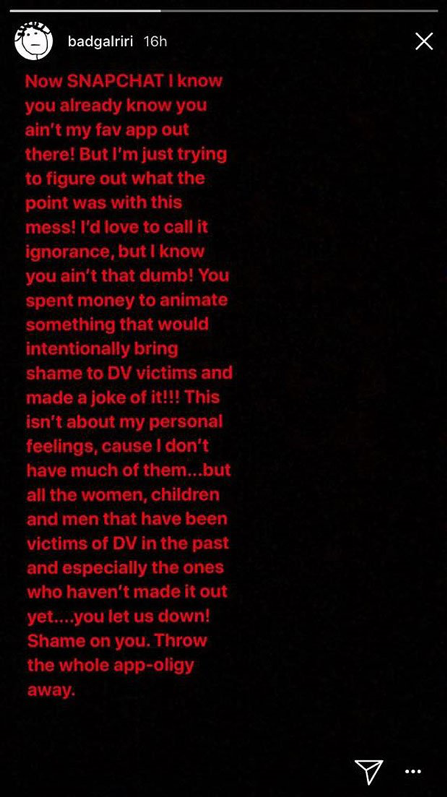
One of the main issues for Snapchat is that Rihanna is a public figure who is living in a ‘glass bedroom’. New media’s networked publics has blurred the public and private aspects of her life and transformed it into a subject of public discourse. Pearson has described the ‘glass bedroom’ metaphor as exchanges that are either “constructed with an awareness of the users beyond the glass walls [and] users outside the bedroom may engage or not” or exchanges that are “more closely guarded… and expecting those outsiders not to stand and watch” (Pearson, 2009). On one hand, Rihanna struggled to keep the DV incident from the public outside of the ‘glass walls’ due to the media and social networking sites. On the other hand, she possessed the power to call out Snapchat through Instagram with the goal of criticising them and holding them accountable (Figure 2).
Snapchat Failed to Recognise Its Invisible Audiences
In Rihanna’s Instagram story, she critiqued Snapchat’s lack of awareness of the invisible audiences the ad may have affected. The affordances of networked publics mean that invisible audiences such as lurkers that “share the same space but are not visible” exist on Snapchat (Boyd, 2010). Snapchat did not account for the fact that the invisible audience may have included past or current victims or other people that have been affected by DV. Historically, DV victims are afraid to speak up about abuse. The real world implication of this ad is that DV victims may feel like they are not being taken seriously if a platform as big as Snapchat endorses behaviour that turns their pain into a joke.
In a period of collapsed contexts, “it can be challenging to contend with groups of people reflect different social contexts and have different expectations as to what’s appropriate” (Boyd, 2010). As a multinational corporation who boasts over 300 million monthly active users around the globe, it becomes difficult for Snapchat to appeal to their users’ differing social expectations (Omnicore Agency, 2019). For instance, the Rihanna ad would have been more triggering to past or current DV victims whereas someone who hasn’t experienced it may see it merely as dark humour.
Failure in Content Regulation by Snapchat and the Implications
Traditional structures governing media have struggled to keep up with the rapid convergence of new and traditional media (Australian Government, 2012). In the US, safe harbour laws protect platforms such as Snapchat from being liable for the content of their users while simultaneously allowing platforms to include additional intervention measures (Gillespie, 2017). Snapchat provides such intervention measures in their ‘Advertising Policies’ which state that all ads are subject to a review process and will be blocked if it falls under ‘prohibited content’ such as advertisements that encourage illegal activity or violence and content that “demeans, degrades, or shows hate toward a particular race, gender culture, country, belief, or toward any member of a protected class” (Snap Inc., 2018). So why was the Rihanna ad (seemingly ticking all those boxes) approved?
The affordances of Snapchat’s internal system allow users to flag inappropriate ads with a tap of their finger. These affordances illustrate Snapchat’s exploitation of the system of ‘participatory culture’ where there are increasingly “low barriers to… civic engagement” and the blurring of the distinction between producers and users (Jenkins, 2006). That is, the users (the public) have the ability to become the producers who curate and moderate content. This juxtaposes the traditional system where the media (e.g. news) provides content and the public merely consumes it. To a certain extent, this system saves human labour and costs. However, Snapchat has a mandate to govern the ads that appear on their platform through an internal review process. If they rely on a system of automation or users flagging ads, it creates opportunities for fails akin to the Rihanna ad to occur.
In fact, the combination of Snapchat’s reliance on participatory culture, automation and the technological affordances of social networking sites and networked publics fuelled the subsequent uproar of criticism. For example, Twitter’s ‘favourite’ and ‘retweet’ functions allowed millions of people to amplify Snapchat’s fail and share it to their followers.
AVOIDING THIS FAIL
Blend of Automation and Humans in the Review Process
To avoid similar fails, I would set up an automated system that flags certain keywords that are contained within a third party ad. A team of humans (from a diverse range of backgrounds and social contexts) should be employed to manually review and approve these ads to make sure that they account for any invisible audiences that may be affected. This team should be accompanied by a separate team who actively moderate content that has been automatically approved by the algorithm but hasn’t gone through humans. Whilst it is not realistic for every single ad to go through a human review process, humans must be a part of the review process in order to reduce the likelihood of similar situations arising in the future. This tightened review process keeps Snapchat’s brand consistent with the company’s ethos.
Improved Crisis Management and Response Framework
Snapchat’s response to the outrage acknowledged that they were wrong and apologised but did not address in detail how the fail occurred (which is crucial to a good crisis management response).
“The ad was reviewed and approved in error, as it violates our advertising guidelines. We immediately removed the ad last weekend, once we became aware. We are sorry that this happened. We are investigating how that happened so that we can make sure it never happens again.”
Snapchat Spokesperson
In fact, Snapchat has not updated the public on their findings or steps that they will take in the future since the making of this statement. From a crisis management perspective, I would have made a formal post addressing the fail and the steps that are being taken to investigate the cause of the issue. Upon the conclusion of investigations, I would have updated the public again on the findings and what frameworks are being put into place to prevent a similar fail from occurring.
Avoiding Sensitive Topics
Additionally, Snapchat should have avoided sensitive topics such as DV without a meaningful purpose (e.g. to raise awareness or support for DV victims). Future, if any, references to sensitive topics should also be accompanied with the relevant resources for help and helplines.
IN THE FUTURE
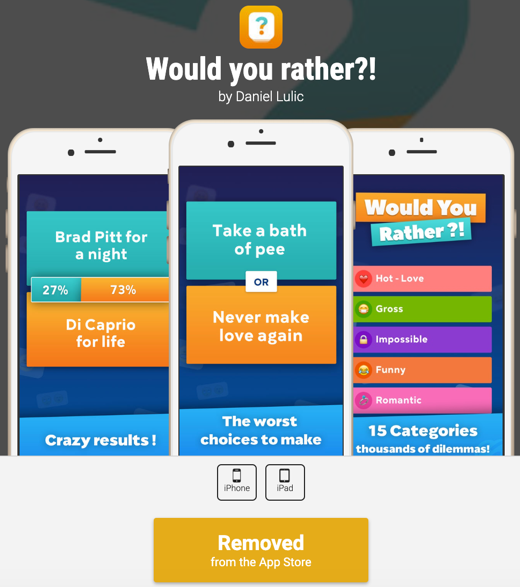
Moving forward, Snapchat should invest time into conducting at the minimum, basic research on third party advertisers. Upon some basic research on the developer of this game, Daniel Lulic, it was revealed that previous games made by him also sparked controversy (Safronova & Bowles, 2018). The app garnered waves of negative reviews on the Apple App Store. Unfortunately, images of these reviews cannot be shown as the game has been removed from the App Store (Figure 3).
However, the New York Times found a review from a user who said, “I am very disturbed with one of the would you rather questions. It’s under humour and it says Would you rather: Get raped by a llama or Rape a llama. No! Rape is NOT a joke!“ (Safronova & Bowles, 2018).
Ultimately, Snapchat did not effectively uphold their advertising policies which led to a disastrous social media fail with serious implications. If the recommendations above are implemented, it will significantly reduce Snapchat’s risks of making the same error again in the future.
BIBLIOGRAPHY
Australian Government. (2012). Convergence Review: Final Report. Canberra: Commonwealth of Australia.
Boyd, D. (2010). Social Network Sites as Networked Publics: Affordances, Dynamics, and Implications. Networked Self: Identity, Community, and Culture on Social Network Sites, 39-58.
Gillespie, T. (2017). Regulation of and by platforms. Thousand Oaks: SAGE Publications.
Jenkins, H. (2006, October 19). Confronting the Challenges of Participatory Culture: Media Education for the 21st Century (Part One). Retrieved from Confessions of an Aca-Fan: http://henryjenkins.org/blog/2006/10/confronting_the_challenges_of.html
Levin, S., & Snapes, L. (2018, March 16). Rihanna wipes $1bn off Snapchat after criticising app for making a ‘joke’ of domestic violence. Retrieved from The Guardian: https://www.theguardian.com/music/2018/mar/15/rihanna-snapchat-ad-domestic-violence-chris-brown
Omnicore Agency. (2019, April 27). Snapchat by the Numbers: Stats, Demographics & Fun Facts. Retrieved from Omnicore: https://www.omnicoreagency.com/snapchat-statistics/
Pearson, E. (2009, March 2). All the World Wide Web’s a Stage: The Performance of Identity in Online Social Networks. First Monday, 14(3). Retrieved from First Monday: https://firstmonday.org/article/view/2162/2127#p3
Safronova, V., & Bowles, N. (2018, March 15). Rihanna Protests Ad on Snapchat That Mocks Domestic Violence. Retrieved from The New York Times: https://www.nytimes.com/2018/03/15/style/rihanna-snapchat-stock.html
Serjeant, J. (2018, March 16). Rihanna urges fans to delete Snapchat after ad mocking assault by Chris Brown. Retrieved from The Sydney Morning Herald: https://www.smh.com.au/entertainment/music/rihanna-urges-fans-to-delete-snapchat-after-ad-mocking-assault-by-chris-brown-20180316-p4z4m7.html
Snap Inc. (2018, January 12). Snap Advertising Policies. Retrieved from Snap Inc.: https://www.snap.com/en-US/ad-policies/
IMAGE REFERENCES
Abad-Santos, A. (2018, March 15). Snapchat ran an ad asking users if they’d rather slap Rihanna or punch Chris Brown. Retrieved from Vox: https://www.vox.com/culture/2018/3/15/17124534/snapchat-rihanna-slap-ad
App Advice. (2018, August 24). Would You Rather?! by Daniel Lulic. Retrieved from AppAdvice: https://appadvice.com/app/would-you-rather/1149281412
Gonzales, E. (2018, March 15). Rihanna Savagely Responds to Snapchat’s Tone-Deaf Ad About Her and Chris Brown. Retrieved from Harpers Bazaar: https://www.harpersbazaar.com/celebrity/latest/a19445760/rihanna-response-snapchat-chris-brown-ad/



 Evan's Blog